November is National Pepper Month, a time to celebrate the diverse world of peppers.
Hot and sweet peppers are important ingredients in many international cuisines. Many chefs, and culinary enthusiasts use this month to explore recipes (see a great one below), spice up meals, and experiment with both sweet and hot pepper varieties. Whether you love the burning sensation of biting into a habanero or prefer to garnish your salad with a green bell pepper, there are many different varieties to choose from.
Did you know? Peppers, both sweet and hot, were first grown in Central and South America and domesticated over 6,000 years ago. Columbus introduced them to Europe after his first voyage to the New World. Portuguese traders eventually brought them to India, southeast Asia, and Africa, where chili peppers were enthusiastically embraced.
The variety of the pepper and the stage of ripeness determine the flavor and color of the pepper. Bell peppers, also known as sweet peppers, are available in a rainbow of colors—green, yellow, orange, red, and even purple varieties. Did you know that a red bell pepper is simply a mature green bell pepper? They have been on the vine longer than green peppers and, in general, the red, yellow, orange, and purple varieties have more nutritional value and tend to be sweeter than green bell peppers.
Jalapeño, chile, and serrano peppers are examples of a spicy cousin to bell peppers. These varieties are smaller than bell peppers. But don’t let the size fool you: these peppers have a lot of heat! If cooking with the spicy peppers, make sure to wear rubber gloves, and make sure you don’t touch your eyes. The oils from these peppers can cause your skin and eyes to burn! To make spicy peppers less spicy, scrape out the white membrane and seeds.
How Hot is Hot? Scoville heat units, developed originally by Wilbur Scoville in 1912, measure the spiciness or pungency of hot peppers. The scale measures the amount of capsaicin—the chemical that makes peppers hot—and assigns peppers a number rating in Scoville Heat Units. Even though the process has changed since Wilbur Scoville’s time, we continue to use his Scoville scale to measure the heat of peppers.
Peppers are a healthy choice, being low in fat and calories and cholesterol-free. Peppers in general are an excellent source of Vitamin C and A (particularly the red bell) and are a good source of potassium, folic acid, fiber, and beta carotene. One cup chopped raw or cooked bell pepper provides one cup of your two-cup daily vegetable requirement.
Take time to appreciate the versatility of peppers and explore new varieties. You can slice them and eat them raw; use them in stir-fry recipes; sauté, roast, pickle, smoke or dehydrate them; or use them to make your own chili powder. Bell peppers are actually a fruit but are prepared and served as a vegetable.

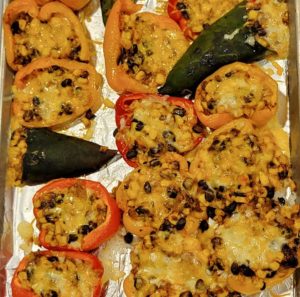
The Piedmont Master Gardeners recently joined the 4-H staff with the “Teen Cuisine” program at the Charlottesville Lugo-McGinness Academy, helping the teenagers learn about peppers. They prepared this tasty Stuffed Bell Pepper recipe. It was voted a winner!
Try this quick, easy, and healthy recipe for your next meal.
Stuffed Bell Peppers
Ingredients
4 large, red, orange or yellow bell peppers, cut in half from the stem to the bottom and cored, seeds removed. (You could also use roasted Poblano/Ancho peppers for a mild spicy version.)
3 tablespoons olive oil
1 medium yellow onion, finely chopped
3 cloves garlic, minced
1 15.5-oz. can of black beans
1 15.5-oz. can or 2 cups frozen corn
½ Tbsp. chili powder
½ tsp. ground cumin
½ tsp. dried oregano
Salt and pepper to taste
Approximately ½ cup tomato sauce
8 oz. Monterey Jack cheese, shredded
8 oz. Cheddar cheese, shredded
Preparation
Preheat oven to 425 degrees.
Step 1
Cut peppers in half and remove core and seeds. Spray or rub with olive oil and sprinkle with salt. Line a tray with aluminum foil for easy cleanup. Roast the peppers for about 20 minutes
Step 2
Sauté the onions and garlic in some olive oil. Stir and cook until soft and translucent, 3-4 minutes. Add black beans, corn, and spices. Spoon in enough tomato sauce to hold together. Remove from heat. Add shredded cheeses to cooled mixture.
Step 3
When peppers have roasted for about 20 minutes, remove from oven and spoon the stuffing mixture into the peppers and top with extra shredded cheese. Place back into the oven for another 20-30 minutes or until the filled peppers are heated through and the cheese is melted.
Serving
Great served over rice with salsa.